Rebuilding Bajaj Finserv's POS loan for the field

Bajaj Finserv

Year

2025

Duration

2 Months

A 30-minute, 11-stage Salesforce desktop tool was being used on mobile browsers by field agents at retail counters across India. Competitors closed the same loan in 11-12 minutes. I led the redesign for mobile web with scan-led inputs, progressive disclosure, in-flow recovery, and a tiered scheme recommendation that embedded business logic into the design itself. The redesigned journey was accepted by the MD of Bajaj Finserv. Application time dropped from 40 to under 20 minutes. Completion lifted from 60–70% on web to 75–85% on mobile

Contributors

Product Managers
Business Head
2 UX Designers
Tech Lead

Why this project?

A customer walks into an electronics store in Lucknow and asks for a phone on EMI. An agent steps in with a tablet while the dealer hovers and the queue grows behind them. In the next 20 minutes, the agent has to find the customer in the system, verify their KYC, scan documents, pick the right scheme, set up a UPI mandate, get the agreement signed, capture the invoice, and submit it for QC. Competitors do all of this in 12 minutes

The tool was built for desktop Salesforce. Used on mobile browsers by agents on their feet. The tool wasn't broken. It was designed for the wrong person

68%

Applications with at least one manual entry error

3x

Browser hops per application (camera, UPI, signature)

40 min

Average application time which is way higher than the competitors

Average application time is way higher than the competitors

About the Users

FOS Agents (Primary)

Feet on Street agents run the entire flow, standing in retail stores and processing 10–15 applications a day. Most speak Hindi or regional languages, work on mid-range Android devices, and deal with patchy in-store networks

Customers (Secondary)

Customers touch the flow only at specific moments which are UPI QR scan, KYC via 3-in-1, loan review. They bring limited patience and varied digital literacy to the counter

Dealer (Stakeholder)

Dealers stand in the background but shape the agent's pace. They want the sale closed before the next customer walks in

"I explain the scheme to the customer while filling the form, so I make mistakes. If it takes too long, they get bored and leave. And I'm switching between 4–5 apps just to finish one application"


FOS Agent

Reliance Digital, Pune

"I explain the scheme to the customer while filling the form, so I make mistakes. If it takes too long, they get bored and leave. And I'm switching between 4–5 apps just to finish one application."


FOS Agent

Reliance Digital, Pune

Competitors who got it right

FOS agents weren't shy about telling us where Bajaj fell short. Many had worked with TVS Credit and IDFC FIRST Bank, and they were clear about what made those tools feel smoother in the field

01

TVS Credit

TVS Credit's Saathi app gave agents a paperless, single-app workflow that handled the entire loan journey end to end. It consolidated loan origination, EMI tracking, and dealer payments into one tool, with a 24-hour disbursal SLA as a hard commitment to the customer

02

IDFC First

IDFC FIRST went a step further with pre-set credit limits via their EMI Card. This eliminated the need for a fresh CIBIL pull at every application and enabled 2-minute instant approvals at the counter, with no-cost EMI as the default option, not the exception

The Constraints

These constraints shaped the redesign more than they limited it. Each design decision had to be grounded in a clear user problem and a measurable outcome

During the Ideation Phase

11 stages mapped on a wall. Two weeks of cross-functional brainstorming. 40+ ideas. Most didn't make it

Dropped

Vernacular interface

Dropped

Voice-led entry

Dropped

AI scheme recommendation

Borrowed

Single-app workflow

Borrowed

Easy Buy-style limits

Borrowed

Instant Approval

Shipped

Tiered scheme cards

Shipped

Pre-filled details

Shipped

UPI resend + QR fallback

Shipped

Asset Card sections

Shipped

Document Library gating

drag to explore

Selling the Vision

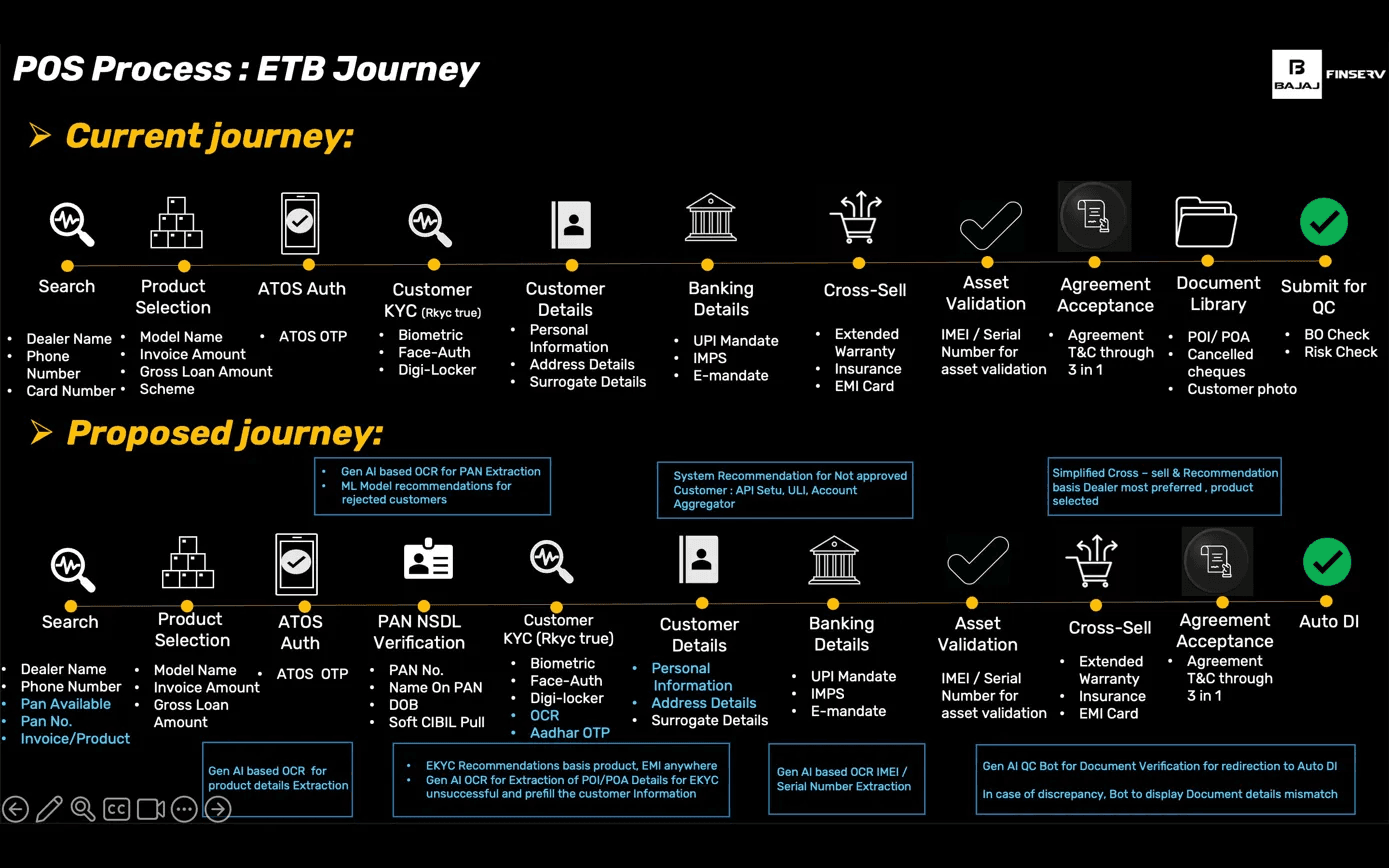
The redesign reshaped the entire journey: Gen AI OCR, soft CIBIL pulls, system-led recommendations for rejected customers, and a QC bot enabling Auto DI

Built with the Business Head, CBO, PMs, and design team. Presented to the MD of Bajaj Finserv by the BH and CBO. As the senior designer leading the work, I was present with the PM team. Accepted

The same system extended to the NTB (New-to-Bajaj) journey, which added a few extra steps for first-time customers like Mobile Verification, Loan Underwriting (Dedupe, PAN, CIBIL), and MITC OTP. The components and recovery patterns stayed the same, so agents never had to learn a separate flow so the interface simply adapted to who was at the counter

The Solution

Every design decision started with a behaviour we observed. Each one is grounded in what the agent was doing or struggling to do at the counter

Customer Search
Progressive disclosure

01

Behaviour observed

Agents were filling Finance Type and Loan Amount before they even knew if the customer was in the system. When the search failed, all that data was wasted.

01

Design call

Show only what's needed to find the customer. Finance Type, Amount Details, and Product Category appear only after the customer is matched

01

Why it works

Reduces cognitive load at the most stressful moment of the flow. The agent doesn't fill what they don't need

01

Behaviour observed

Agents were filling Finance Type and Loan Amount before they even knew if the customer was in the system. When the search failed, all that data was wasted.

01

Design call

Show only what's needed to find the customer. Finance Type, Amount Details, and Product Category appear only after the customer is matched

01

Why it works

Reduces cognitive load at the most stressful moment of the flow. The agent doesn't fill what they don't need

Customer Search
Progressive disclosure

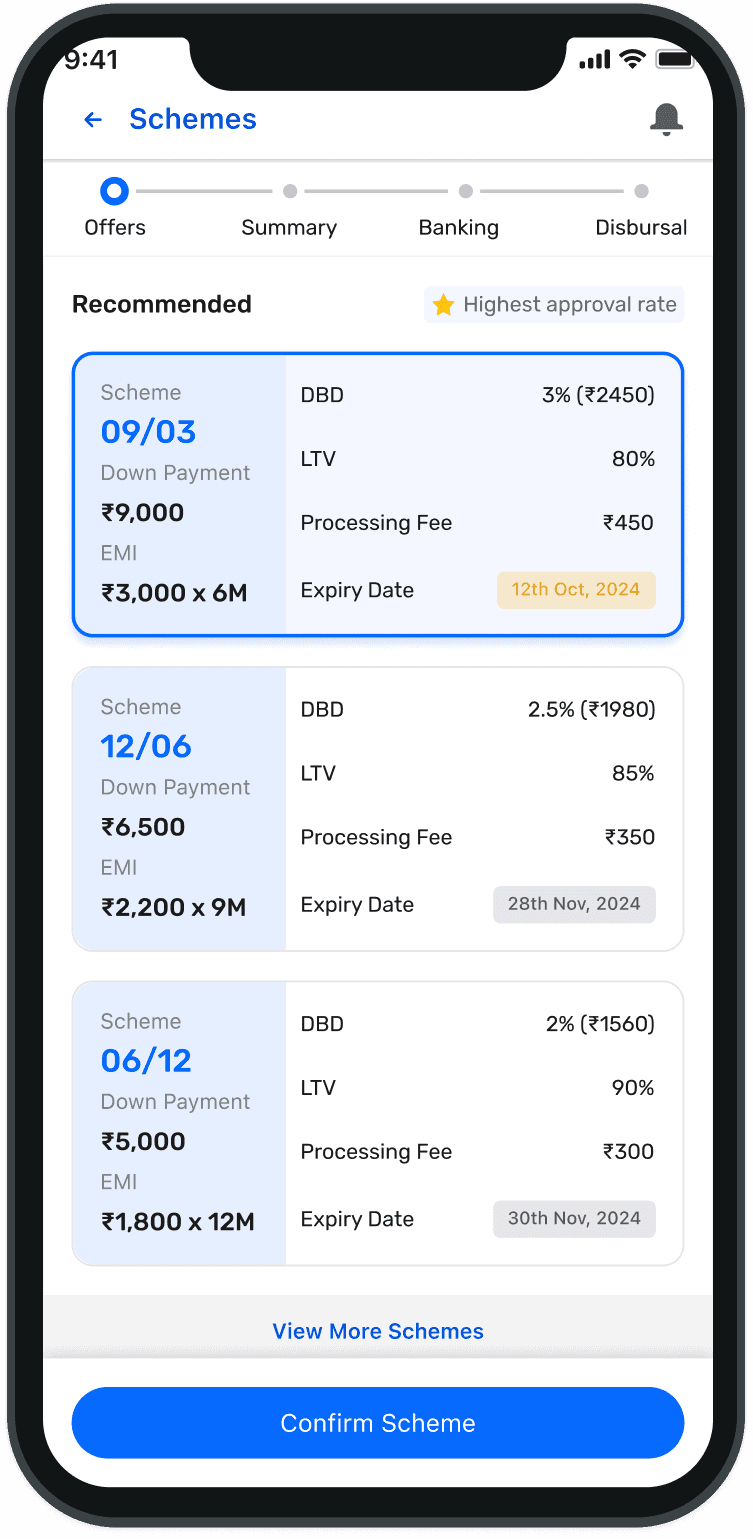
Scheme Selection
With Tiered Recommendation

01

Behaviour observed

Agents were picking lower-margin schemes by accident because all schemes looked identical. Business pushed certain schemes; agents had no signal of which to choose

01

Design call

A "Best Match" card at the top with full detail and a social proof tag: "Chosen by 8 in 10 customers". Other recommended schemes present below in compact rows. Lower-margin schemes accessible via a de-emphasised "View other schemes" drawer with an info note explaining their use case.

01

Why it works

Business intent becomes visible in the design itself. Agents recommend with confidence. Customers feel the choice is curated, not random.

Scheme Selection
With Tiered Recommendation

01

Behaviour observed

Agents were picking lower-margin schemes by accident because all schemes looked identical. Business pushed certain schemes; agents had no signal of which to choose

01

Design call

A "Best Match" card at the top with full detail and a social proof tag: "Chosen by 8 in 10 customers". Other recommended schemes present below in compact rows. Lower-margin schemes accessible via a de-emphasised "View other schemes" drawer with an info note explaining their use case.

01

Why it works

Business intent becomes visible in the design itself. Agents recommend with confidence. Customers feel the choice is curated, not random.

Enhance Offer
Single-Select List

01

Behaviour observed

Original screen grouped Phone Lock and Mandate Lock into separate accordions. Agents thought they needed to pick one from each. They were selecting two offers when only one was allowed

01

Design call

Flat list of all four offers with category badges (Phone Lock / Mandate Lock) on each card. Single selection across the entire screen

01

Why it works

The grouping no longer implies a false hierarchy. One screen, one decision, and no confusion

01

Behaviour observed

Original screen grouped Phone Lock and Mandate Lock into separate accordions. Agents thought they needed to pick one from each. They were selecting two offers when only one was allowed

01

Design call

Flat list of all four offers with category badges (Phone Lock / Mandate Lock) on each card. Single selection across the entire screen

01

Why it works

The grouping no longer implies a false hierarchy. One screen, one decision, and no confusion

Enhance Offer
Single-Select List

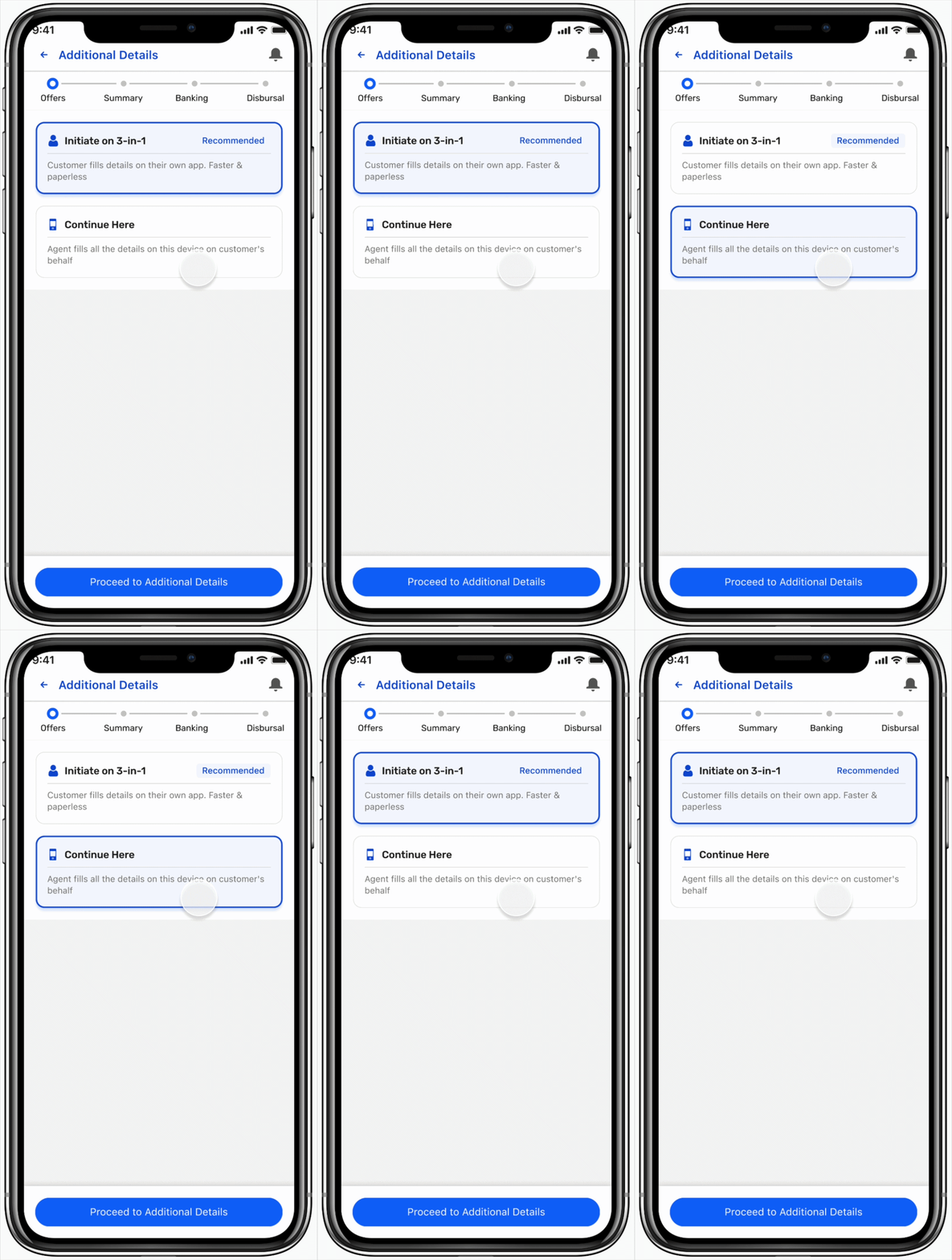
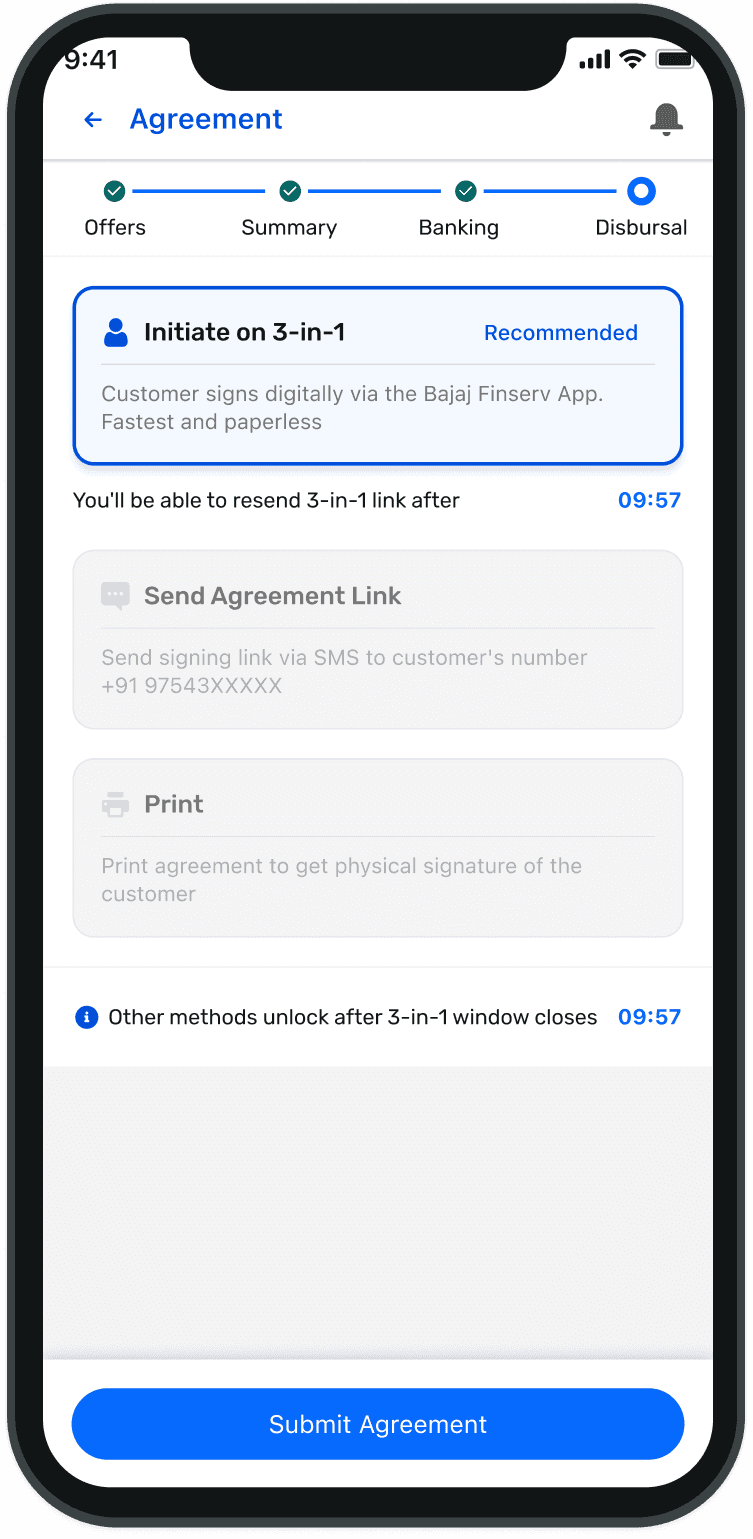
Additional Details + Agreement
Using 3-in-1 App

01

Behaviour observed

Agents were using "Continue Here" as default to fill customer details on their own device. Efforts increased for the agents and digital adoption stayed low

01

Design call

Make 3-in-1 Bajaj Super App (customer fills on their own) the default selection. Add a "Recommended" tag with reason: "Faster · Paperless · Customer-led"

01

Why it works

A soft nudge embedded in the interface drives adoption without forcing it. Agents see the recommended path, customers stay in control of their own data

Additional Details + Agreement
Using 3-in-1 App

01

Behaviour observed

Agents were using "Continue Here" as default to fill customer details on their own device. Efforts increased for the agents and digital adoption stayed low

01

Design call

Make 3-in-1 Bajaj Super App (customer fills on their own) the default selection. Add a "Recommended" tag with reason: "Faster · Paperless · Customer-led"

01

Why it works

A soft nudge embedded in the interface drives adoption without forcing it. Agents see the recommended path, customers stay in control of their own data

UPI Mandate
Recovery State Designed

01

Behaviour observed

When SMS failed, agents restarted the entire mandate flow. 5–10 minute delays per stuck application

01

Design call

Two-state resend (cooldown countdown → active resend), QR code as parallel method, session expiry timer, auto-updating waiting state, structured "Try Another Method" with reason capture and skip option.

01

Why it works

Every failure point has a designed next step. Agents never hit a dead end and don't start a new application

01

Behaviour observed

When SMS failed, agents restarted the entire mandate flow. 5–10 minute delays per stuck application

01

Design call

Two-state resend (cooldown countdown → active resend), QR code as parallel method, session expiry timer, auto-updating waiting state, structured "Try Another Method" with reason capture and skip option.

01

Why it works

Every failure point has a designed next step. Agents never hit a dead end and don't start a new application

UPI Mandate
Recovery State Designed

Asset Card
System Detour Handling

01

Behaviour observed

SFDC required agents to pick an opportunity ID mid-flow. Agents thought they had left the loan journey. Some restarted the application

01

Design call

Sections by status (Active, Pending, Rejected, Completed) with count badges. Search bar. Quick filter chips including "Today's Applications". Bottom sheet for details

01

Why it works

A system constraint becomes a structured detour rather than a confusing exit. Agents stay oriented

Asset Card
System Detour Handling

01

Behaviour observed

SFDC required agents to pick an opportunity ID mid-flow. Agents thought they had left the loan journey. Some restarted the application

01

Design call

Sections by status (Active, Pending, Rejected, Completed) with count badges. Search bar. Quick filter chips including "Today's Applications". Bottom sheet for details

01

Why it works

A system constraint becomes a structured detour rather than a confusing exit. Agents stay oriented

StackedScroll — visible in Preview only

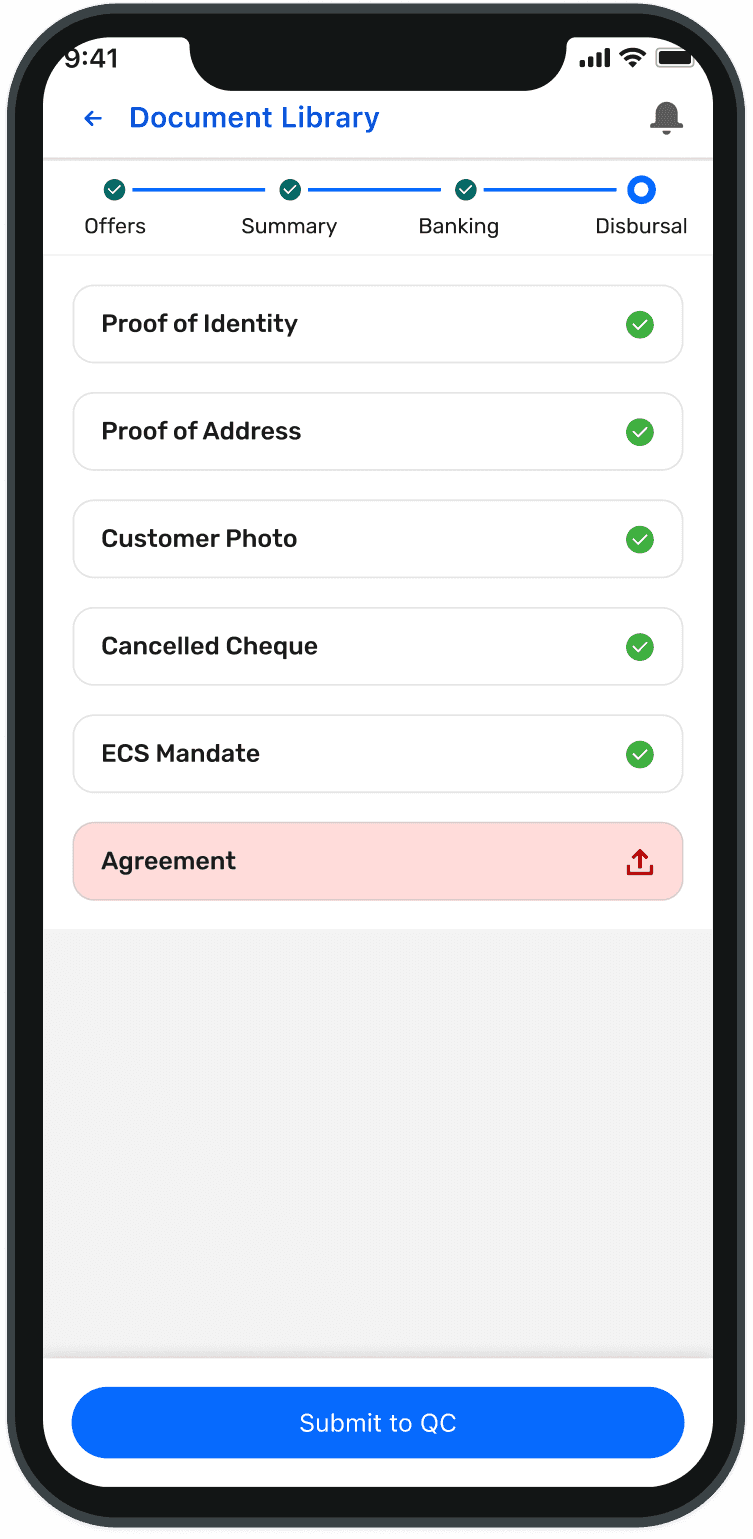
Handling the Edge Cases

The Impact

0min

Application time at the POS counter, halved

Application time at the POS counter, halved

0%

Start-to-completion rate, lifted on mobile

0

Stages with manual entry replaced by scan-led input

0

Browser hops eliminated through camera, UPI and agreement

0

Stages the agent experiences, through progressive disclosure

Best viewed on desktop. Switch over for the full case study

Lets

design

build

create

together!

Social

DISHA K

Lets

design

build

create

together!

Social

DISHA K

Lets

design

build

create

together!

Social

DISHA K